Thank you
Thanks for reaching out. We will get back to you soon.
Oops! Something went wrong while submitting the form.


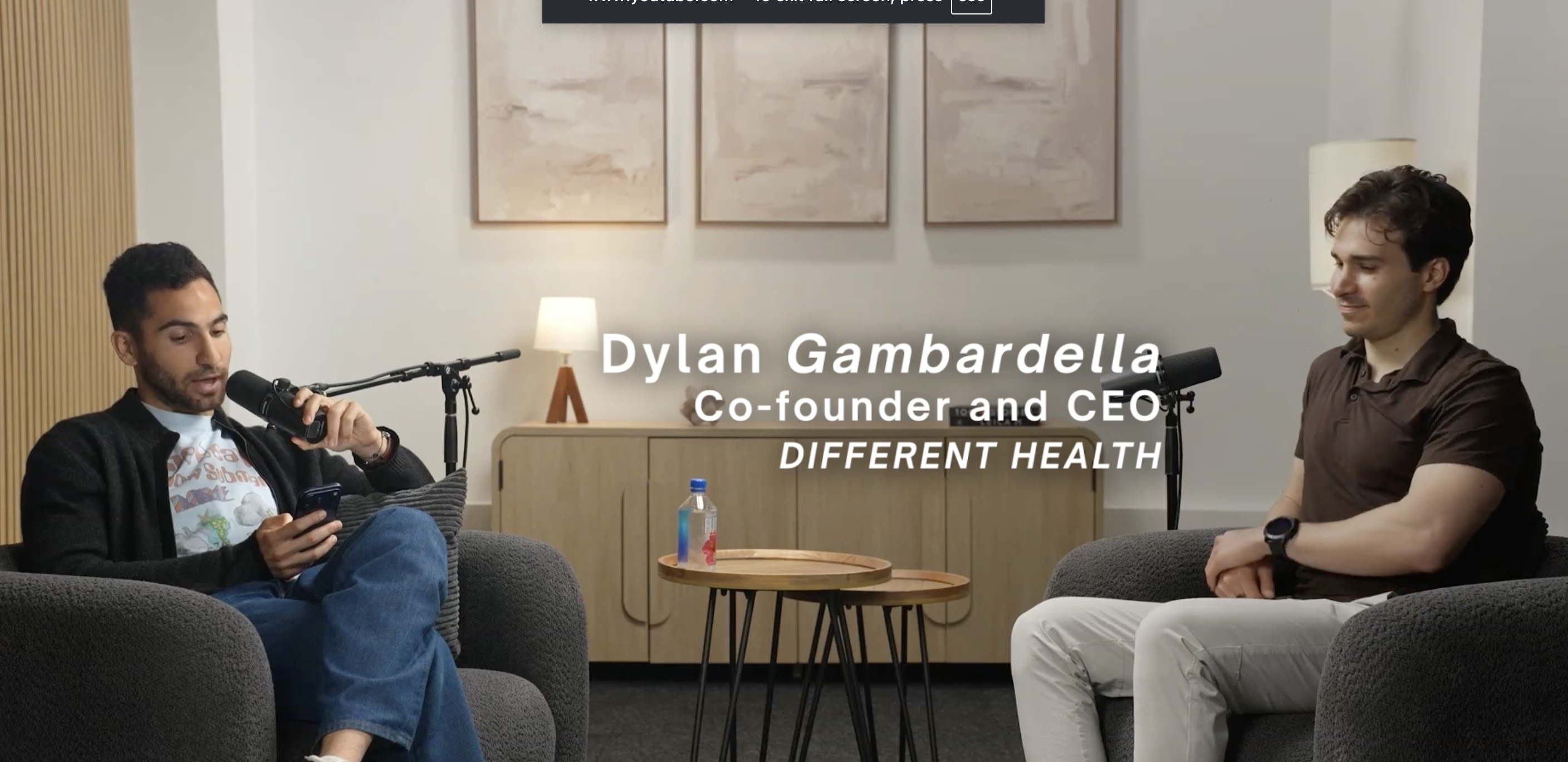

Most executives are funding everything but themselves. Their company gets a strategy. Their team gets resources. Their health gets a 15-minute annual physical: two minutes with a doctor, a basic blood panel, and a stamp of approval that means nothing.
Dylan Gambardella watched this pattern for a decade while building NextGen HQ, a career platform that eventually touched 200,000 rising leaders. The operators he worked with were optimizing every variable in their business and ignoring the one that determines how long they can stay in the game. That observation became the founding thesis of Different Health, a biomarker-driven, tech-enabled longevity platform that brings elite diagnostics and functional health coaching directly to high-performing teams.
Here is what preventative healthcare actually looks like for high performers, why the legacy sick care model is structurally incapable of delivering it, and how Different Health is building the infrastructure to make it the default.
The traditional annual physical is a liability check, not a performance baseline. A doctor spends two minutes with a stethoscope, runs a standard blood panel, and tells you everything looks fine. What it doesn't measure: your ApoB, your VO2 max, your metabolic health, your fall risk, your resting heart rate trend, or any of the biomarkers that actually predict how you perform and how long you perform at that level.
The problem isn't the doctor. It's the model. The legacy sick care system is reactive by design. It waits until something breaks, then charges to fix it. Prevention isn't the product. Treatment is.
For high performers, this is an operational failure. The same person who would never run a company without financial reporting is making health decisions with no data, no baseline, and no monitoring. The gap between how seriously operators take business performance and how seriously they take physical performance is the market Different Health was built to close.
The structural flaw runs deeper than the physical exam. It runs through the insurance model itself.
Most health insurance operates on a churn assumption. The insurer expects you to switch plans, because you switched jobs, because your employer changed providers or any number of other reasons that make multi-year commitments unlikely. That assumption makes investing in your preventative diagnostics a losing bet for the insurer. By the time an early intervention pays off in better health outcomes, you're already on someone else's plan.
The result is a system where no one has the financial incentive to invest upfront. Employers pay the same premiums regardless of whether their team is healthy. Insurers don't benefit from prevention. Employees bear the downstream cost in performance, energy, and eventually medical bills.
Self-insured employers break this logic. They own their insurance P&L directly, which means they benefit immediately when their employees are healthier. They spend less on emergency care, GLP-1s, and chronic condition management. For tenured employees, the CFO who's been there for eight years, the VP who's been there for ten, the ROI on preventative investment compounds over the length of that tenure. Different Health recently closed a major county government with 1,000 pensioned police officers. For a government entity on the hook for lifetime healthcare costs, every dollar invested in prevention is a direct taxpayer dollar saved.
The Different Health model starts with a question most health platforms never ask: what does success look like when you're 80?
The goal Gambardella articulates is not just lifespan. It is healthspan. Living 100 years matters less if 20 of those years are spent in declining health. The clinical objective is to close the gap between how long you live and how well you live during that time. That requires more than a blood panel. It requires a complete picture.
The member journey at Different Health takes approximately four hours and covers every measurable dimension of health performance. It starts with an onboarding call that captures full family history, because longitudinal context changes how biomarker data gets interpreted. From there, members complete advanced blood work, then a two-hour in-person physical that includes VO2 max testing, strength assessment, mobility and balance evaluation, fall risk analysis, range of motion measurement, and full metabolic health evaluation.
The output is roughly 1,000 biomarker data points. But data is not the product. Interpretation is. Different Health's coaches take those 1,000 data points and build a plan that fits the actual constraints of your life. A McKinsey exec who travels four days a week and eats three meals a week in airports gets a different protocol than someone coming off the couch for the first time in five years. The plan is built around your one available hour, not the five-hour program you won't execute.
Gambardella wears a CGM, an Oura Ring, and a Garmin. He's also clear about how most people are using wearables wrong. Checking your daily HRV score and feeling anxious about a low number is not health optimization. It's a new source of stress layered on top of the problem you were trying to solve.
The strategic use of wearable data is trend-based, not score-based. The question isn't what your HRV is today. It is how your HRV moved over the two weeks after you changed your sleep schedule. What happened to your resting heart rate during your last heavy travel stretch? Where does your blood glucose spike, and what dietary change would flatten that curve during a high-stress week?
At Different Health, that wearable data feeds directly into the platform. Coaches see the trends, see the member's calendar, and reach out proactively. The member doesn't need to open an app or interpret a dashboard. The insight comes to them.
Different Health goes to market through employers, and the pitch has three tiers.
The first is retention. The cost of losing a high-performer: recruiting fees, onboarding time, lost productivity during the gap. That number is well-documented and consistently underestimated. A health benefit that employees actually talk about, that they attribute to their employer, and that produces visible results in how they feel and perform is a retention lever that compensation alone can't replicate.
The second is productivity. For a trading firm, a hedge fund, a law firm, or any organization where cognitive performance drives revenue, a 2% improvement in mental acuity across the senior team is not a rounding error. It's a material number. Energy, focus, and recovery speed are not soft metrics. They are inputs to output.
The third is insurance cost. For self-insured employers, every preventative diagnostic that catches something early, and every lifestyle intervention that prevents something from developing, translates directly to claims that don't get filed. The exact ROI math is still being built as Different Health accumulates longitudinal data, but the directional logic is simple: a population of people who lift weights, sleep well, and know their biomarkers will cost less to insure than one that doesn't.
Different Health is currently live in New York City and expanding to California and South Florida. The employer is the entry point. The vision is something broader.
Gambardella's stated goal is to make preventative health the default option, not the premium one. A Different Health in your apartment building. A Different Health in your office building. A world where accessing elite diagnostics doesn't require a specialist referral, a six-week wait, and a two-hour commute. It requires walking downstairs.
The longer-term vision is the one that makes the comparison to an annual physical feel inadequate. Gambardella wants the DH360 to become what every physical looks like, not a Different Health-specific product, but the standard against which every primary care exam is eventually measured. Whether it's Different Health that gets there or someone else, the bar for what a physical should capture is already set.
The founders and executives who perform at the highest level for the longest time are not the ones who got lucky with genetics. They are the ones who treated their health like they treat their businesses: with data, with systems, and with the understanding that the inputs compound.
Preventative healthcare for high performers is not a wellness trend. It is an operational strategy. The ones who are building it into their infrastructure now, through diagnostics, biomarker monitoring, and functional coaching, are not ahead of the curve. They are simply doing what the data has always suggested: you cannot perform at an elite level on a system you've never actually measured.
The physical that tells you you're fine is not a baseline. It is an absence of information. Different Health is building what a real baseline looks like.
If you enjoyed this article, subscribe to The Unordinary's Podcast.
.svg)