Thank you
Thanks for reaching out. We will get back to you soon.
Oops! Something went wrong while submitting the form.



There is a private-equity deck landing in every property manager’s inbox roughly every other week: a sponsor, a thesis, and a plan to roll up a fragmented industry into something big enough to sell. The problem is that most roll-ups quietly destroy the very companies they acquire. The moment you merge everything into one brand and one system, the friction begins, and the assets you paid for start walking out the door.
The operator behind this conversation learned that the hard way, then turned the lesson into an edge. After bootstrapping his own firm through four competitor acquisitions and a sale to the largest residential manager in the country, he went on to source and originate add-on deals that drove roughly twelve percent of the acquirer’s total revenue, including a landmark acquisition of a name-brand brokerage’s management arm. He has seen integration done badly, done too cautiously, and finally done right.
The conclusion is counterintuitive and worth tattooing on the wall of any acquirer: merge the back office, and leave the brand alone. Everything client-facing stays untouched. Only the invisible plumbing gets combined. Get that split wrong and you will lose clients and employees you actually care about within six months.
Around 2016 and 2017 the standard move was to buy a company and absorb it completely: one name, one system, one org chart. He did it, and the eventual acquirer of his own firm was doing the exact same thing at the exact same time. Both arrived independently at the same verdict. It was a bad idea. There is simply too much friction, and small businesses feel it worse than giants, because a small firm has no team of people sitting around waiting to run an integration. Every department is already fully loaded.
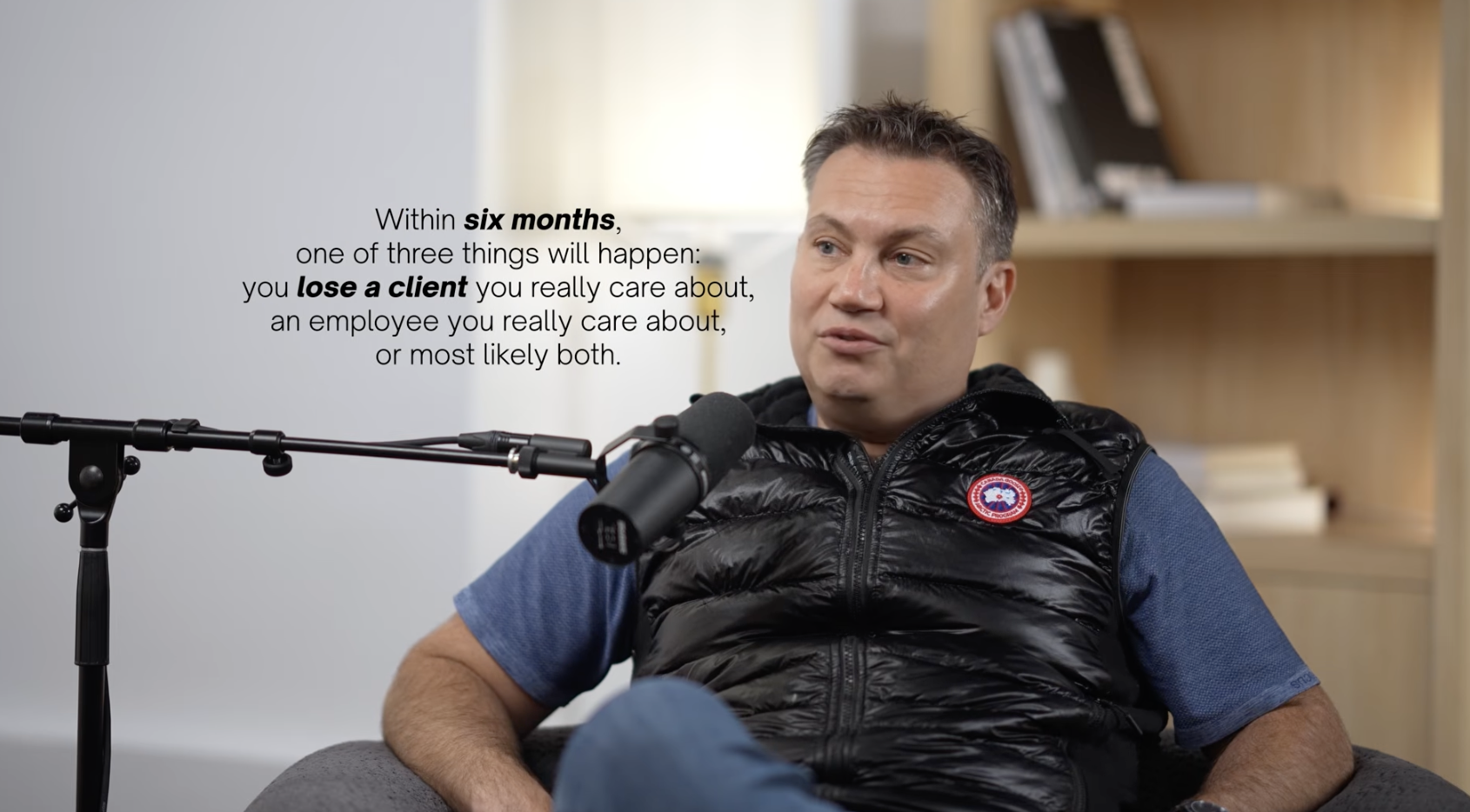
His rule of thumb is brutal and specific. Within six months of a heavy integration, one of three things happens: you lose a client you genuinely care about, you lose an employee you genuinely care about, or, most likely, both. And you do not even save that much to justify the damage. When he pressed one Florida operator on why he had fully merged seven acquired companies, the honest answer was that he wanted the name. That is ego, not strategy, and ego is an expensive reason to break a working business.
After full integration failed, the natural overcorrection was to keep every acquired company completely separate. That did not work either. Total separation leaves all the duplicated cost and none of the scale advantage. The answer that finally held is a hybrid, and the dividing line is the whole insight.
The largest acquirer in the space runs precisely this playbook, keeping its acquired brands distinct while quietly unifying the machinery underneath. It is also the honest answer to the fantasy that AI will simply erase all these roles. On a long enough horizon technology helps, but the front-line jobs are not going anywhere soon. The back-office roles that could be offshored already were, and a serious real estate owner in New York has no interest in handing his building to a faceless, low-cost virtual employee.
The single most underpriced risk in any acquisition is what the acquired team believes is about to happen to them. The first thought in every employee’s head when they hear the word acquired is a simple one: am I going to lose my job. If you do not address that directly and repeatedly, the fear does your integration damage for you.
The approach here is disciplined. Reassurance is not a one-time speech, it is the first speech, the fourth speech, and the seventh speech, and it centers on how genuinely important the work is. This is people’s shelter. It touches life and safety. It is also honest about its own limits: telling a team that nothing will change is inauthentic, because things always change. The commitment is narrower and more credible, that changes will be judicious and deliberate. One concrete signal of respect stands out: he never walks into the seller’s office, before the acquisition or after it. The people and the culture that made the company worth buying are left intact.
A huge pool of management operations has historically never traded, specifically the ones attached to owner-operators who also hold the real estate. Understanding why is the key to unlocking them, and there are four reasons. First, they want to control the operation because they care deeply about the underlying real estate. Second, the interests are misaligned: a management company is incentivized to charge the client as much as is fair and legal, while the owner wants to be charged as little as possible. Third, they typically do not make much money on the operation itself, since their focus is rightly on the assets. Fourth, and most dangerous for a buyer, if the owner ever sells the buildings, every management contract vanishes with them.
He claims to have engineered a deal structure that solves all four at once, which, if it holds, opens a category of targets nobody else can buy. There is a parallel, lower-risk opportunity sitting in plain sight for existing operators, too. Most rental-only firms have no condo or co-op division, and vice versa. Adding the owned side, the HOA and co-op work, is low-hanging fruit, because it is relatively easy to move rental staff onto that side, the transfer and estoppel work is highly profitable, and unlike rental contracts that can evaporate when a landlord sells a building, HOA relationships tend to run in perpetuity. When Blackstone pulled its properties back in-house from third-party managers, one of those managers lost a quarter of its book overnight. Recurring revenue that cannot be yanked away is worth building toward on purpose.
Acquisition value is not created at the closing table. It is preserved, or destroyed, in the ninety days after it. The operators who win at roll-ups are the ones who resist the ego pull of one big unified brand and instead run a disciplined split: consolidate the plumbing, protect the relationships, and over-communicate to the people who are quietly deciding whether to stay.
The deeper principle is that the things worth buying, the client trust, the local brand, the tenured team, are exactly the things a clumsy integration erases. Handle them like the assets they are. Merge the back office, leave the brand alone, and buy the businesses everyone else considers impossible to buy.
If you enjoyed this article, subscribe to The Unordinary's Podcast.
.svg)